Late on March 10th, I arrived in Dubrovnik. Two days earlier, on March 8th, Italy had expanded its coronavirus lockdown from a small town in Lombardy to much of northern Italy. On March 9th, the lockdown had been expanded to the entire country. Hostel owners in Greece had told me about increasing coronavirus cancellations, but my dorm room in Dubrovnik was almost full.
On March 11th, I woke up to two notifications, one from a sports app and one from a news app. The NBA had suspended its season after a player had tested positive for COVID-19. And the WHO had declared coronavirus a global pandemic.
The mood in the common area was apprehensive. There were backpackers in the hostel who had gotten out of Italy just days before the lockdown, and the possibility that we could get trapped in a quarantine zone was becoming much more real. Some still downplayed the actual disease – “It’s just the flu, everybody’s in a panic right now” – but nobody could deny the border closures.
On the morning of March 12th a New Zealander walked into the dorm room and announced “Forrest Gump has coronavirus!”, which must have come as quite a surprise to those who were still asleep. People were changing their travel plans. One girl from Montreal left suddenly in the evening to catch a flight through Marseilles, while an Argentinean spent the day on the phone trying to get hold of an airline, any airline, to get a ticket home.
I was stubborn. I didn’t have much waiting for me at home, and I didn’t want to leave until I’d at least gotten to Berlin, a city that had been on my bucket list for years. I called my parents to tell them I still wanted to keep going. I was on my way to Sarajevo, but flights got a lot cheaper once I got to Belgrade. Once I got to Serbia I could figure out my next steps.
It took a little over 24 hours to change my mind.
It started when I turned my phone on in the bus station in Dubrovnik. I’m fortunate to have a network of friends who are well-educated and well-informed, who I can talk to from anywhere with an internet connection. As a group, they’re smart, discerning, and not prone to panic. And as a group, they were worried.
Sitting on the bus, a brilliant red Croatian sunset painting my window, I traded messages with friends in Canada, the U.S., and Europe. The message was unanimous: Get home, and fast. By the time I crossed the Bosnian border and my phone data stopped working, I’d reluctantly come to a decision: it was time to go.
The next day, March 14th I was sheepishly admitting to other backpackers that I’d booked a ticket out of Sarajevo back to Canada for March 16th. In an empty restaurant in Mostar we discussed the situation.
There were six of us: myself, two Belgians, two Swiss, and another Canadian. Us Canadians were making arrangements to get home. The Belgians were in a bind – they’d sublet their apartment for three months for this trip and were hoping to keep pushing on for just a little while longer. The Swiss were cavalier – “It’s pretty bad in Switzerland right now. I think I’d rather be stuck in Bosnia.”
We wished each other luck as we parted ways.
*
I’d been hearing about the coronavirus since mid-January 2020, while I was in Taiwan. Taiwan, as has been reported in many places, took the illness seriously from the beginning, to a point that seemed absurd at the time. I had my temperature checked in a small museum on Green Island, a tiny island with no more than 2,000 people off Taiwan’s east coast. I was one of five people in the building, including the two staff. But they took my temperature anyway and asked me to sanitize my hands.
My Taiwanese relatives obsessed over my safety, showering me with face masks and sanitizing wipes. My aunt checked in with me almost as much as my mother, and I kept receiving instant messages updating me on the virus’s progress. I rolled my eyes and ignored them – I was young, healthy, outside of disease hotspots, and generally not in close contact with many people. I wore a mask on public transit and airplanes to appease those who were worried but beyond that didn’t change my behaviour much.
It didn’t help that most other places weren’t on quite as high alert as Taiwan. There was a noticeable decrease in alarm going from Taiwan to Japan in early February. The most visible sign of concern, the face mask, was worn by maybe one in three Japanese, as compared to one in two to three in four Taiwanese. Not that the Japanese didn’t take it seriously – but they took it casually enough that it was possible to relax and ignore it.
Among backpackers in Asia, COVID-19 wasn’t much of a concern. It came up very occasionally in conversation, but mostly as gossip about what was happening in other places. I think those in the know had an inkling of what was coming, though. In Osaka, over beers, I chatted with a Scottish doctor and two Australians who had been orderlies.
“We had a case of bird flu in our hospital,” said one of the Australians. “The cleaning and disinfecting we had to do was crazy. That was just for one case, and we knew where it came from. I can’t imagine what it’s like for the coronavirus right now.”
“It’s scary,” they all agreed. “But I think I’d rather catch it here in Japan than back home.”
In my last few days in Japan I caught a small cold – wet cough, sneezing, and fever. I worried, but not about COVID-19. I knew my cold had been brought on by overexertion in the previous week – and besides, COVID-19 is a dry cough. I worried about getting on a plane with cold symptoms, scaring the people around me and possibly being singled out for quarantine by an overeager public health officer. Selfish? Possibly. Regardless, I spent my last days in Japan sleeping it off.
Luckily the symptoms cleared up quickly. On February 24th, with little more than a tickle in my throat, I boarded a plane in Tokyo and flew to Europe – not knowing how quickly things would develop over the next three weeks.
*
From Mostar, I arrived in Sarajevo after dark on the 14th. With the trip coming to an end, I’d splurged on a nice hotel in the old town, and would have one full day to explore the city before catching an early morning flight on the 16th. The streets were quiet – unusually so, my taxi driver noted.
I arrived at the hotel to bad news.
“We’ve been ordered to shut down,” the receptionist told me. “You need to cancel your reservation. Also, you need to check in with the Bosnian Health Authority.”
On top of that, my morning flight out of Sarajevo – the first leg of three flights back to Canada – had been cancelled.
“I’m sorry,” the receptionist said in accented English. “This is a catastrophe.”
He helped me find a new hotel – to this day I don’t understand why mine was the only one closed – and my flight was rebooked to leave on the morning of the 17th. But now I could feel the urgency – if I hadn’t already decided to leave, the night of the 14th would have sealed the deal for me.
On March 15th my flight was cancelled again. This time, I waited in vain for them to rebook. No airline in the world was accessible by phone, so on the 16th I headed to the Sarajevo airport to catch whatever plane was available. “I’ll take whatever I can get,” I told the agent. “I’ll sleep in the airport if I need to. But, uh, anything but Chicago O’Hare.”
They booked me an afternoon flight to Vienna, followed by an early morning flight to Frankfurt and from there to Vancouver. I hastily threw a change of clothes into my carry-on and headed for security.
Later, in the boarding area, somebody tapped me on the shoulder. It was the Swiss backpackers from Mostar. “We changed our minds,” they admitted. “Just booked the ticket today.”
*
The last 16 hours or so from Sarajevo to Frankfurt were tense. I knew that I’d be in the clear the instant the plane’s wheels left the runway in Frankfurt, but the threat of further airport closures hung overhead like a guillotine blade.
The Canadian government made an announcement on March 16th. From my hotel room in Vienna, I chatted nervously with friends while keeping an eye on the CBC livestream. The anxiety heightened my frustration: Why was this press conference starting half an hour late? Why was the Prime Minister using his “Better is Always Possible” voice, with its many. Dramatic. Pauses? Was I going to be able to get home?
The announcement ended up being straight to the point, but chilling in its own way. Canada was closing. Canadian citizens and permanent residents could return home as long as they were healthy, but foreigners and anyone showing symptoms would be turned away. I could get home, for now, but I felt like I was racing toward a shutting door. The worldwide network of airports and roads that until recently had let me go anywhere in the world was suddenly constricting around me. I went to bed early, still worried.
All was quiet when my alarm went off at 2:45 AM. No news alerts, no emails about flight cancellations. I slowly came down from my nervous high as I made my way to the Vienna airport, and by the time I got to Frankfurt I finally started to relax.
Ten hours later, mid-day on March 17th, we descended over the snow-capped Rockies to Vancouver airport. I’d made it – just under the wire, as it turned out. Austria announced as I landed in Frankfurt that it was expecting to stop all flights in Vienna airport in the coming days, and two days later, all of Canada’s major news networks – Globe & Mail, Postmedia, CBC – were running stories on Canadians stranded overseas as the borders closed.
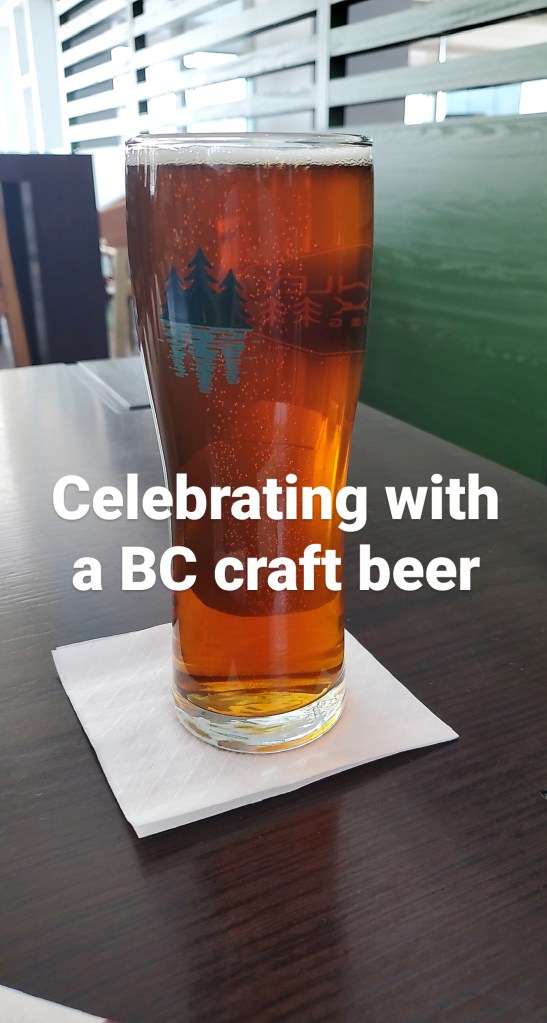
Waiting in Vancouver Airport for my last flight to my parents’ house, I celebrated my escape with a beer. No place like home.
 Harmon Moon